You've decided to straighten your crooked, crowded or gapped teeth — but now you face two options: classic braces, or the increasingly popular clear aligners. Both are effective at aligning teeth, but they differ in comfort, looks, treatment time and cost.
In this guide we compare both methods in detail, list their pros and cons, and explain which one suits which situation, so you can make the right decision together with your orthodontist.
The Short Answer: Which One Is Right for You?
A simple rule: for mild to moderate problems, clear aligners are ideal for people who value aesthetics and can use them with discipline. For complex, advanced cases, braces give stronger, more predictable control. So there is no single "better" method — there is the one that's right for you, and your orthodontist determines that.
What Are Braces?
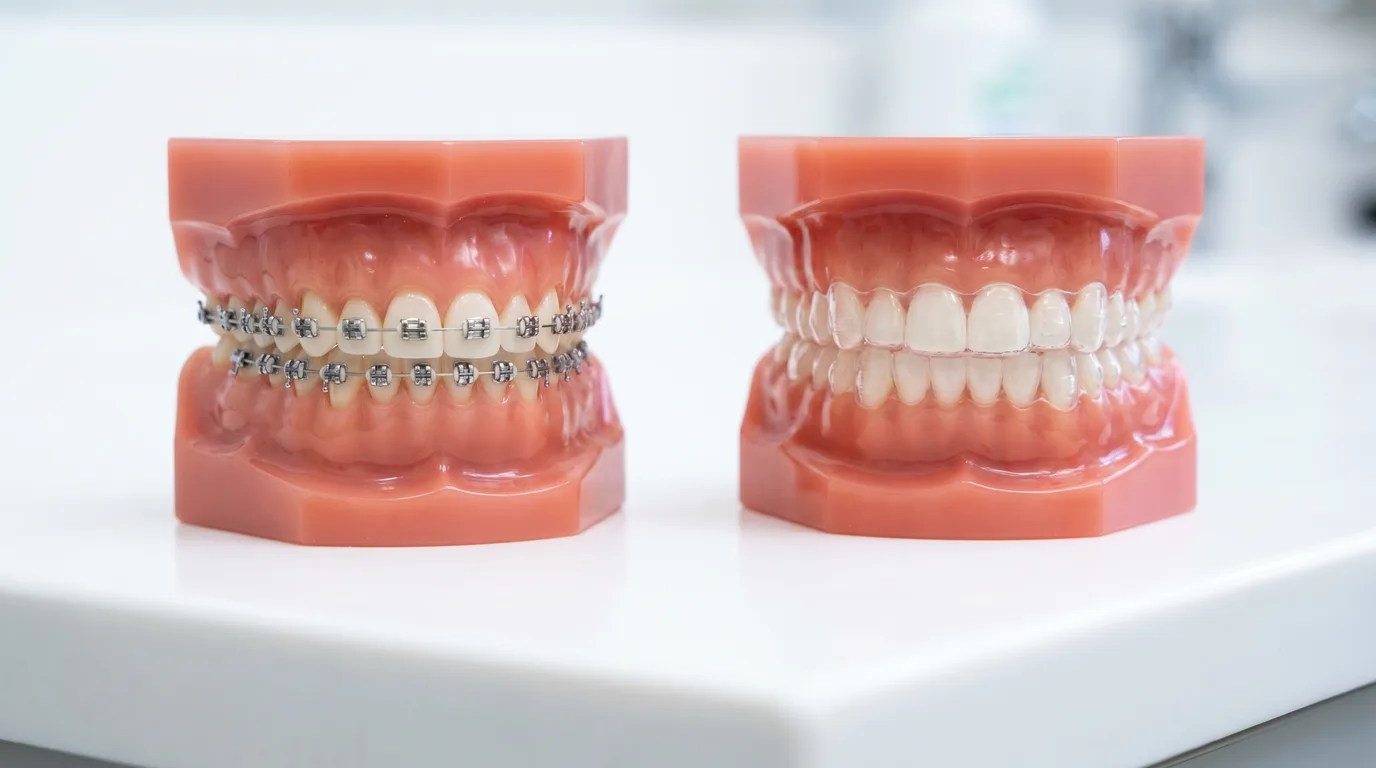
Braces are the classic orthodontic method: small brackets are bonded to the teeth and connected by wires that gradually move the teeth into the correct position. They are fixed, meaning they are not removed during treatment. The main types are:
- Metal brackets: The most common, most affordable and most durable option.
- Ceramic (clear) brackets: Tooth-coloured and less visible, but more fragile.
- Lingual brackets: Fitted to the inner surface of the teeth, invisible from outside.
Pros: Effective in every type of case (especially complex ones), work continuously and depend less on patient discipline. Cons: Visible, can irritate in the first days, require avoiding some foods and make brushing harder.
What Are Clear Aligners?
Clear aligners are custom-made, nearly invisible, removable orthodontic appliances. A series of trays, each moving the teeth a little further, is usually swapped for the next every 1–2 weeks. They must be worn 20–22 hours a day and are removed for eating and brushing.
Pros: Nearly invisible, easy eating and hygiene because they're removable, no metal irritation, and fewer check-up visits. Cons: Success depends entirely on consistent wear; they may fall short in very complex cases and can be lost or forgotten.
Braces vs Clear Aligners: Comparison Table
| Feature | Braces | Clear Aligners |
|---|---|---|
| Appearance | Visible (except lingual) | Nearly invisible |
| Removability | Fixed | Removable |
| Eating | Some foods to avoid | Remove and eat freely |
| Hygiene | More effort | Easy (normal brushing) |
| Comfort | Irritation early on | Generally more comfortable |
| Case suitability | Any case, incl. complex | Mild–moderate ideal |
| Patient dependence | Low | High (discipline needed) |
| Check-up frequency | More frequent | Less frequent |
Which One in Which Case?
Clear aligners stand out when: there is mild–moderate crowding, small gaps, aesthetics matter a lot (adults such as teachers, presenters, professionals) and the patient can wear them with discipline.
Braces are more suitable when: there is severe crowding, significant bite (jaw) problems, cases needing tooth rotation or major root movement, and patients (especially younger ones) who may not wear aligners consistently.
Treatment Time and Follow-up
With both methods, the duration depends on the difficulty of the case, usually between 6 and 24 months. With braces, the wires are tightened at intervals, so check-ups are more frequent. With aligners, the tray sets are changed at home and check-ups are less frequent. At the end of treatment, a retainer is essential with both methods to stop the teeth drifting back.
Care and Hygiene
With braces, cleaning around brackets and wires takes an interdental brush and care; otherwise white spots and decay risk increase. With aligners, you brush normally, and the trays are cleaned gently with lukewarm water. It is important not to expose the trays to hot water (they deform) and to brush your teeth before putting them back in.
The Cost Difference
In general, metal braces are the most affordable option; ceramic and lingual brackets and clear aligners cost more. However, the final price depends on the difficulty of the case, the treatment time and the brand used. For an accurate comparison, it's best to get a personalised quote from your dentist.
For Children and Adults
In growing children, braces (and extra appliances if needed) are often preferred, especially when jaw growth needs guiding. In adults, where aesthetics are a priority, clear aligners are very popular; but suitability is always decided by individual assessment. Age alone is not the deciding factor.
Common Myths About Clear Aligners
There are a few common misconceptions about clear aligners. "Aligners fix every case" is not true; in complex cases they can fall short on their own. "They are always faster" doesn't hold either; the duration depends on the case. The most dangerous myth is "it's fine if I don't wear them": if they aren't worn 20–22 hours a day, the teeth don't move as planned and treatment drags on. And being more expensive doesn't automatically make a method "better"; the right choice is always determined by the case.
What to Know Before You Start
Whichever method you choose, a few steps matter for a healthy start. First your tooth and gum health is assessed; any decay or gum problem is treated before orthodontics. Then a digital scan or impression is used to build the treatment plan, and you're shown the estimated duration and expected result. Remember: after treatment ends, wearing a retainer is the key to lasting results with both methods. Regular check-ups and good oral hygiene keep the outcome for life.
The Bottom Line
Braces and clear aligners reach the same goal (a straight, healthy smile) by different routes. If aesthetics and comfort are your priority and your case allows it, aligners stand out; if a complex correction or strong control is needed, braces do. You make the best decision together with the orthodontist who assesses your teeth and your expectations.
Learn more about orthodontic options and the method best for you on our orthodontic treatments page. Book a free consultation for a personalised assessment.