If you are missing most or all teeth in one jaw, one of the first big decisions you will face is this: All-on-4 or All-on-6? Both are full-arch implant solutions. Both can replace an entire row of teeth with fixed, natural-looking restorations. Both are done successfully every day in Turkey for international patients. Yet they are not identical, and the better option depends on your bone anatomy, bite force, health profile, and goals.
In this 2026 guide, we compare All-on-4 and All-on-6 in practical, patient-friendly terms: who each treatment is designed for, what surgery and healing feel like, how pricing works, and what long-term performance you can realistically expect. By the end, you should know exactly which questions to ask during your consultation and which plan is more likely to suit your case.
Quick Answer: What Is the Core Difference?
All-on-4 uses four implants per jaw, often with angled posterior implants to maximise available bone and avoid extensive grafting. All-on-6 uses six implants per jaw, distributing load across more support points and typically offering extra biomechanical stability when bone volume allows.
- All-on-4: fewer implants, often more cost-efficient, excellent for reduced posterior bone in many cases.
- All-on-6: more implants, broader load distribution, preferred when stronger support and long-term redundancy are priorities.
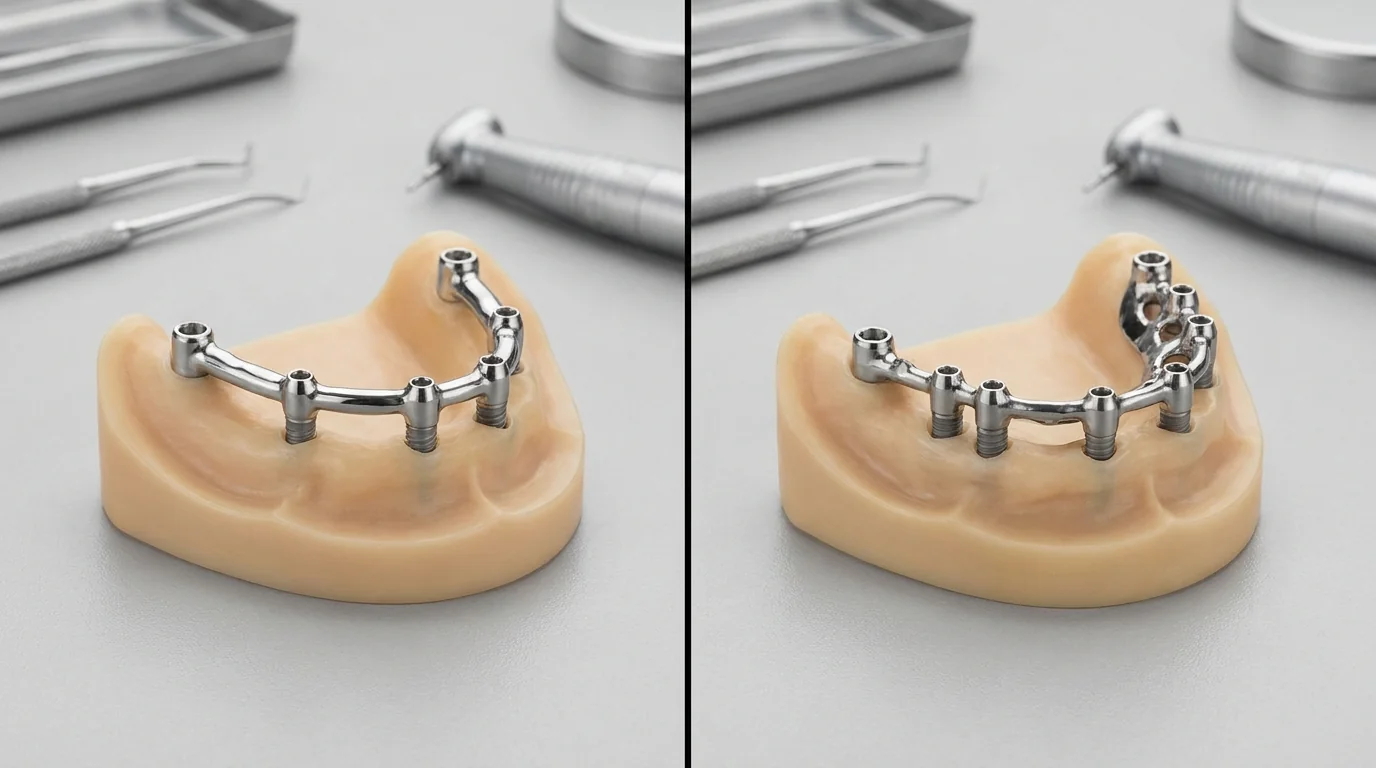
Neither is universally “better.” The right answer is patient-specific.
How Full-Arch Implants Actually Work
In both protocols, implants are placed in the jawbone and connected to a fixed full-arch prosthesis. Most clinics in Turkey provide an immediate provisional bridge (same-day or next-day in suitable cases), then replace it with a stronger final bridge after healing and osseointegration. The final restoration is commonly acrylic-hybrid or zirconia, depending on your plan, budget, smile line, and bite pattern.
So this is not “4 teeth vs 6 teeth.” It is the number of implant anchors supporting one full arch. The prosthetic design, material, occlusion, and maintenance protocol matter just as much as implant count.
Who Is a Better Candidate for All-on-4?
All-on-4 was designed to help patients with moderate posterior bone loss avoid major grafting where possible. By angling rear implants, surgeons can often engage denser anterior bone while avoiding sinus and nerve structures.
- Patients with reduced bone in posterior maxilla/mandible.
- Patients seeking a fixed full-arch solution with fewer implants and lower total cost.
- Patients suitable for immediate loading under controlled bite conditions.
- Patients who value a streamlined surgery with fewer osteotomies.
When planning is accurate and prosthetics are well-executed, All-on-4 can deliver excellent long-term outcomes and high patient satisfaction.
Who Is a Better Candidate for All-on-6?
All-on-6 is commonly preferred when bone quality/volume is sufficient and the patient has higher functional demand (strong bite, parafunction risk, larger arch, or desire for increased structural redundancy).
- Patients with adequate bone for six implants without extensive grafting.
- Patients who want broader force distribution across the arch.
- Cases where long-span stress reduction is a key goal.
- Patients prioritising maximum support over minimum implant count.
Biomechanically, additional support points may reduce load per implant and improve prosthetic stress behaviour, especially in challenging occlusal patterns.
Bone Volume, Bone Quality, and 3D Planning: The Real Decider
The most important variable is not price or marketing label. It is anatomy. A reliable clinic should perform CBCT-based planning, evaluate cortical engagement, assess ridge width/height, map anatomical limits, and model prosthetic position before final recommendation.
In practical terms:
- If posterior bone is limited, All-on-4 may be the safer and more efficient route.
- If bone supports six fixtures predictably, All-on-6 may offer added long-term confidence.
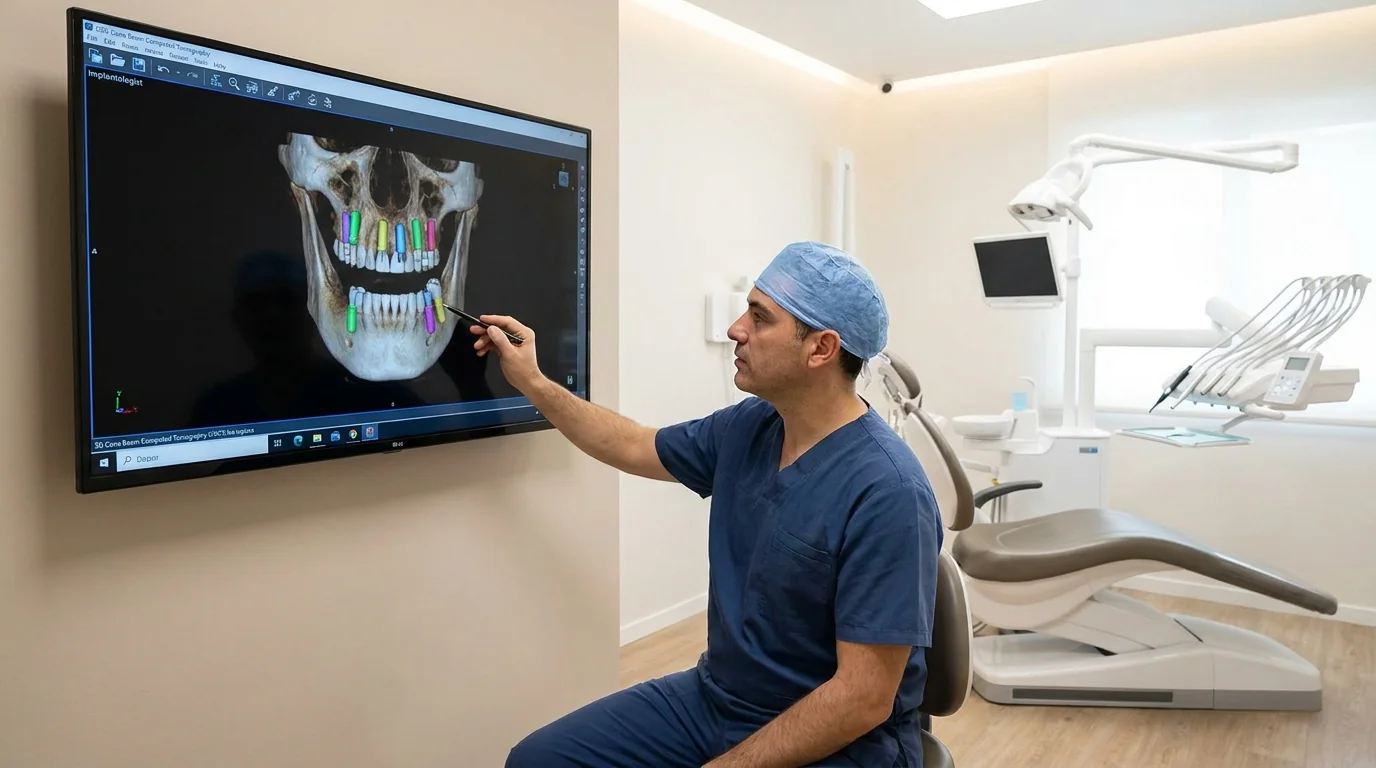
Any clinic that recommends one option before full diagnostics is oversimplifying your case.
Stability and Long-Term Performance: Is More Always Better?
Patients often assume six implants are automatically superior. In reality, long-term success depends on multiple factors: surgical precision, implant position, primary stability, prosthetic fit, occlusal design, hygiene access, and maintenance discipline.
All-on-6 can provide mechanical advantages through wider load sharing, but a well-planned All-on-4 can still perform very successfully for many years. Conversely, a poorly planned All-on-6 can fail despite having “more implants.”
So the hierarchy is usually:
- Correct diagnosis and treatment design
- Correct surgical/prosthetic execution
- Correct maintenance and recall
- Implant count
Surgery, Recovery, and Daily Comfort
From a patient perspective, both procedures are generally manageable with local anaesthesia and optional sedation. Typical short-term effects include swelling, pressure, mild bruising, and temporary dietary limitation.
Recovery pattern is usually similar for both protocols, but All-on-6 may involve slightly more surgical time due to extra sites. That said, experience and protocol matter more than raw implant number. In skilled hands, both can be efficient and comfortable.
Most patients return to light routine quickly, follow a soft-diet phase during early healing, then transition to normal function after progressive review and final prosthesis delivery.
All-on-4 vs All-on-6 Cost in Turkey (2026)
Turkey remains a leading destination because clinics can offer internationally comparable materials and technology at significantly lower total fees than UK, US, or Western Europe.
| Treatment (per jaw) | Turkey (avg.) | UK / W. Europe | United States |
|---|---|---|---|
| All-on-4 | €3,500 – €6,000 | €12,000 – €18,000 | $20,000 – $28,000 |
| All-on-6 | €4,500 – €7,500 | €15,000 – €22,000 | $24,000 – $32,000 |
Indicative 2026 ranges. Final quote varies by implant brand, prosthesis material, anatomical complexity, and whether adjunctive procedures are required.
If your case can safely be solved with All-on-4, choosing All-on-6 only for “marketing reassurance” may not provide proportional clinical value. If your anatomy and bite profile clearly benefit from six implants, the additional investment may be worthwhile.
Travel Timeline for International Patients
Most international pathways include:
- Pre-arrival online review: photos, medical questionnaire, previous imaging if available.
- Visit 1: diagnostics + surgery + provisional full-arch bridge.
- Healing phase: remote follow-up while osseointegration progresses.
- Visit 2: final bridge impressions/records and definitive prosthesis fitting.
Exact duration depends on protocol and healing response, but this two-step model is common for both All-on-4 and All-on-6 in Turkey.
Complications, Risk Management, and What to Ask Clinics
Any surgery has risks. What separates safe clinics is not “zero risk” promises, but transparent risk control and realistic planning. Ask:
- Which implant system/brand is used, and what warranty is documented?
- Will I get CBCT-based planning and a written treatment plan?
- Is immediate loading appropriate for my case, or not?
- What is included in pricing (provisional, final bridge, follow-ups)?
- How are bite adjustments and aftercare handled once I return home?
Red flags include vague pricing, no clear prosthetic timeline, and recommendations made before diagnostics.
A Practical Decision Framework
Use this simple logic:
- If bone limits posterior support and surgeon can achieve stable strategic placement: All-on-4 may be ideal.
- If bone allows six fixtures and your functional demand is high: All-on-6 may be preferable.
- If cost pressure is significant but prognosis remains strong with four: All-on-4 is often the efficient choice.
- If you need extra biomechanical confidence and can fund it: All-on-6 can be justified.
Final decision should always come after full clinical exam and 3D planning, not before.
Real-World Patient Scenarios
To make this more practical, here are common patterns seen in full-arch consultations:
- Scenario A: 62-year-old patient, advanced tooth loss, reduced posterior maxillary bone, moderate budget pressure. In many such cases, a strategically planned All-on-4 can deliver predictable function and aesthetics without over-treatment.
- Scenario B: 55-year-old patient, broad arch, high bite force, parafunctional history, sufficient bone in both arches. All-on-6 is often considered to improve load sharing and reduce long-span stress.
- Scenario C: 68-year-old patient currently wearing unstable removable dentures, anxious about surgery, seeks simpler pathway and quick confidence restoration. All-on-4 is frequently selected when diagnostics support stable immediate provisionalization.
- Scenario D: 49-year-old patient seeking “one major treatment for life,” strong functional demand, and willingness to invest in maximal support. If bone allows, All-on-6 may align better with those priorities.
These are not rules; they are patterns. Your individual diagnosis may point in a different direction, which is exactly why a written treatment rationale matters.
What Should Be Included in Your Quote?
When comparing clinics, a low headline figure can be misleading if major items are excluded. Ask for itemized confirmation of:
- CBCT diagnostics and digital surgical planning
- Implant brand/model and authenticity documentation
- Number of implants and surgical protocol details
- Immediate provisional bridge (if planned)
- Final bridge material (acrylic-hybrid vs zirconia), lab stage, and delivery visits
- Post-op medications, controls, and emergency support policy
- Any potential extra-cost triggers (grafting, extractions, revisions, relines)
Transparent planning reduces unpleasant surprises and helps you compare options by clinical value, not just marketing price.
Maintenance: The Part Most Patients Underestimate
Whichever protocol you choose, longevity depends heavily on maintenance. Full-arch restorations are not “fit and forget.” Patients who do well long-term usually follow a strict but simple routine:
- Daily cleaning under the bridge with suitable tools (superfloss, water flosser, interdental protocol advised by clinic).
- Regular professional hygiene and screw/occlusion checks at recommended intervals.
- Early reporting of mobility, unusual bite changes, recurring soreness, or speech changes.
- Protective night-guard strategy when bruxism risk exists.
In practical terms, maintenance quality can influence outcome more than whether you have 4 or 6 implants. A well-maintained All-on-4 often outperforms a neglected All-on-6.
All-on-4 vs All-on-6: Final Verdict
In Turkey, both All-on-4 and All-on-6 can be excellent full-arch solutions when selected for the right patient and executed by an experienced implant team. The question is not “Which one is better on the internet?” but “Which one is better for your jaw, bite, and long-term plan?”
At VDS Dental, we evaluate each case with a prosthetic-first approach and transparent diagnostics. If you want a personalised recommendation, start with an online assessment and compare options side by side before you travel. You can also review our dedicated pages for All-on-4 and All-on-6.